


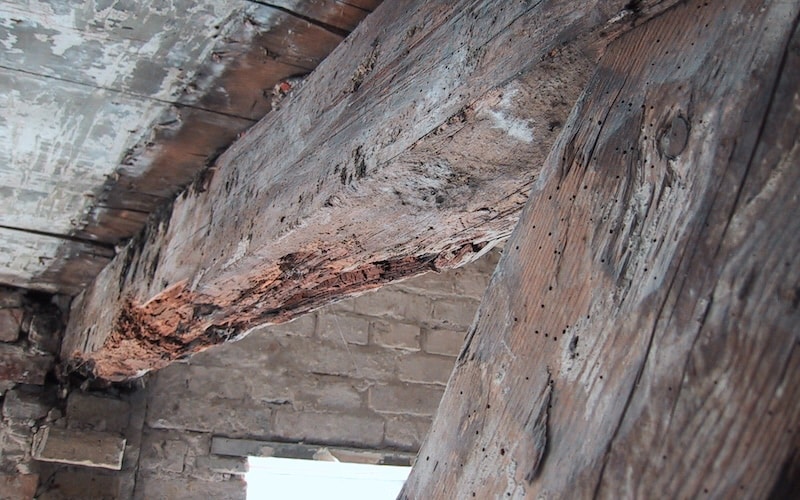
Climate change may mean an increased risk of insect damage
Written by Henrik Møller Jørgensen, Technical Manager at PROTOX
Higher temperatures and increased moisture can increase the risk of heightened activity from wood-boring insects such as common furniture beetles and house longhorn beetles. Climate change therefore also places new demands on professional pest controllers.
Climate change does not only affect the natural environment outside buildings. Higher temperatures, milder winters, more periods of heavy rain and more frequent moisture damage can also alter the conditions for wood-destroying insects living in the timber of buildings.
For pest controllers, the development means that the risk of attacks by, among other things, woodboring beetles and house longhorn beetles may increase. This applies to both the frequency of attacks, the length of the insects' active period and the structural conditions that make the wood suitable as a habitat for the insects.
Warmth can increase insect activity
Insects are ectothermic, and their development is therefore directly affected by temperature. When the temperature rises, eggs can hatch more quickly and the larvae's metabolism increases, whereby the period of flight, mating and egg-laying can become longer.
For house longhorn beetles, warm loft spaces and sun-warmed structures are particularly relevant. Higher summer temperatures can create favourable conditions in roofs, attics and dark structures where the larvae live hidden in the softwood. At the same time, a longer warm season can increase the period during which adult beetles are active and can spread to other wooden parts or buildings.
Milder winters can furthermore improve the survival rate for certain insects and make it easier for species that were previously limited by low temperatures to establish themselves.
Precipitation – also part of the risk picture
Temperature is only one part of the risk picture. Increased precipitation, torrential rain and floods can lead to the dampening of woodwork, for example in the loft, crawl spaces and basements.
If the moisture is not detected and dried out, the wood's moisture content can rise to a level where the common furniture beetle gets better conditions for development. The species is therefore often seen in connection with leaks, condensation, inadequate ventilation, or wood that lies close to damp and cold building components.
Even minor leaks can over time create local moisture problems that are not visible from the living area. An attack can therefore be a sign of a hidden building problem and not just an isolated insect problem.
Heavy rain also increases the risk of acute water damage. Following a flood or roof leak, woodwork can remain damp for a long time, especially in enclosed structures. This does not necessarily cause an insect attack straight away, but can make the wood more susceptible in subsequent years.
Tightly sealed buildings can trap moisture
Energy renovation and sealing of buildings reduces heat loss, but can at the same time alter the ventilation and moisture balance. If a building is retrofitted with insulation or sealed without sufficient ventilation, moisture can accumulate in ceilings, walls and other structures.
This can create a favourable environment for both wood-destroying fungi and insects. Climate adaptation should therefore not just be about keeping the rain out, but also about ensuring that any moisture that enters can dry again.
Prevention is becoming more important
In the future, a rapid response following cloudbursts and floods will be a central part of preventing both fungal and insect damage. Timber must be dried effectively, and hidden areas should be inspected before the moisture damage develops into a long-term problem.
The best protection against wood-boring insects is a combination of building maintenance, moisture control in the building, adequate ventilation and early inspection, as well as professional remediation with preventative wood treatment against wood-destroying insects.