


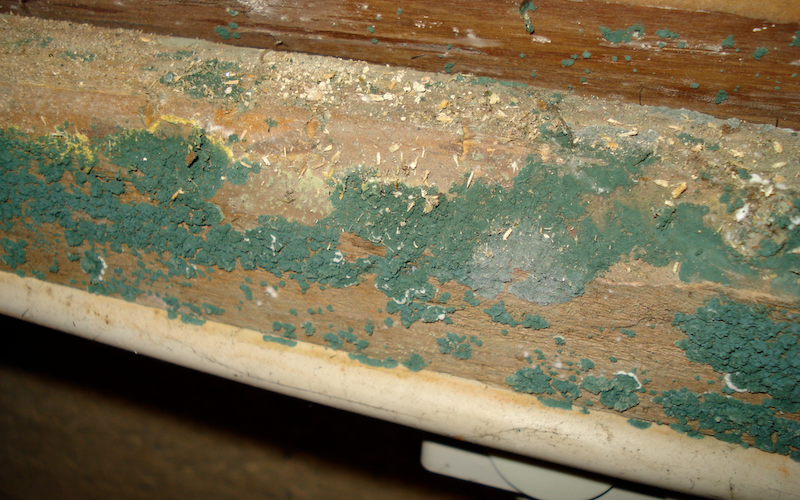
As a general rule, a mould infestation should always be disinfected and the mould removed, but we also have to recognise that there are certain situations and certain locations where it is just not possible to carry out an effective remediation.
Examples of inaccessible places with mould:
- Mould growth on a plywood sub-roof in a building with sloping walls or where the space is used all the way to the ceiling. You can look down and see that there is mould, but you just can't get around to remediating it.
- Raised floors where the gap of maybe 10 cm is utilised for cable routing etc.
- Very low crawl spaces that you just can't get into.
- Blocked containers and other similar inaccessible places.
Of course, it is possible to solve such problems by tearing down the entire structure and rebuilding, but in many situations this is completely pointless.
Alternatively, you can fix the mould and spores to prevent them from spreading.
Sealing method
If mould has developed in such a place due to water damage, condensation or other dampness, it is of course always important to remove the source of moisture and ensure drying out.
If it is not possible to thoroughly clean the infestation afterwards, you can choose to seal and encapsulate the fungus so that it can no longer release spores or other unpleasantness.
To fulfil this task requires a product with a relatively high content of the right binder and the right combination of fungicides.
Mould infestation in the outdoor environment
If there is a mould infestation in what is defined as an outdoor area, which can also be the underside of a roof in an uninhabited loft space, the underside of the floor in a crawl space, in the garage, and similar locations, then we recommend using KOMBI PROTECT to resolve the issue.
Mould attacks the indoor environment
If attacks occur in indoor environments. This could be under raised floors, under containers, etc., the fungicide content in KOMBI PROTECT is unnecessarily high, which is why we have developed FORSEALER (MR70). With the same binder content but with a significantly reduced fungicide content, it provides exactly the same mould-sealing effect. However, FORSEALER (MR70) can be used anywhere indoors without concern.
Sealing is a good and economically attractive alternative in places where it is practically impossible to carry out actual mould removal.
Schematically, the process looks like this:
Available:
Out: Clean and prevent with KOMBI PROTECT
India: Clean and prevent with MR60
Unavailable:
Out: Seal with KOMBI PROTECT
India: Seal with MR70
It is always very important that the choice of treatment method is agreed with the property owner and any advisor. If the sealing method with SEALER (MR70) is used, it is especially important that the performance requirements are fully coordinated.
A superficial inspection of the treated areas will show that mould still seems to be present, as the seal itself is colourless and the mould has not been removed.
A test with PRO-CLEAN or similar method, however, will show that the sponge is sealed and thus "harmless".
KOMBI PROTECT and SEALER (MR70) can be supplied with a green marker colour to indicate that a treatment has been carried out.