


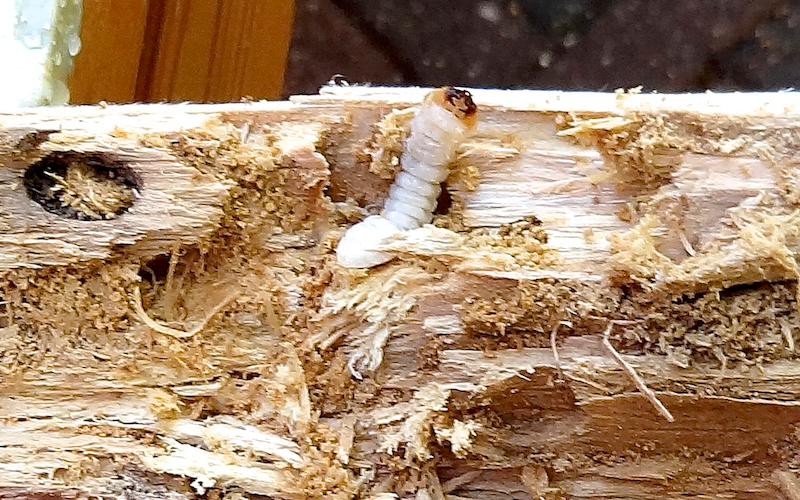
Get rid of wood-boring insects
You sometimes hear that kerosene or diesel oil can be used to exterminate beetles in woodwork. Neither of these remedies has any proven effect, and they will only work if you get so much of the liquid into the wood that the larvae actually drown in it. Both products are flammable and contain easily vaporisable and harmful substances that it is not appropriate to bring into the house. If you used diesel oil in e.g. For example, if you used diesel oil in a roof construction to combat beetles, it would probably also cause a very unpleasant diesel odour that most people wouldn't want to live in.
Use approved products against wood-boring insects
The right way to get rid of wood pests is to always use a product that is approved by the Danish Environmental Protection Agency. That way, you'll never go wrong and you can be sure that the product is both effective and that it fulfils the environmental requirements of the law. Sometimes it can be difficult to find out what pests you have in your woodwork. Knowing this is essential for the right treatment. That's when you need to turn to one of the excellent consultancies that specialise in biological damage in buildings.
At Protox, we have two different approved products that can be used against wood-damaging insects.
As a professional, you can buy both INSECT and KOMBI PROTECT, while as a private individual you can only buy KOMBI PROTECT.
The difference between the two products is that INSEKT is applied by spraying, whereas KOMBI PROTECT may only be applied with a brush and roller (therefore, private individuals may use KOMBI PROTECT). Both products prevent insects from attacking new areas of the woodwork, but INSEKT has the best ability to stop an attack where insects are currently active. In return, when using KOMBI PROTECT, you will get a treatment that simultaneously prevents insect attack and attack by wood-destroying fungi and mould.
After treating the wood
Even after thorough and correct treatment of the woodwork with PROTOX products, some “activity” in the form of “dust” may still occur over a longer period, which is entirely natural.
When you treat wood with an insecticide, it doesn't penetrate the wood completely, but only forms a "poison barrier" in the outermost millimetres of the wood. The beetle larvae don't realise this as long as they remain deep in the wood - below the "poison zone" where they can stay for several years, completely unaffected by the poison on the surface. But when it gets old enough to want to come out and mate, it gnaws its way under the surface and pupates, at which point it comes into contact with the poison and dies.
You will therefore find that the infestation dies out slowly over a period of a few years. If you want a faster effect, you need to carry out a deep impregnation in the form of valve impregnation with Protox Insect. Valve impregnation is also the right approach for painted surfaces or very large and inaccessible timber dimensions.
Also be aware that even if the beetle infestation is completely knocked down, timber can drip when exposed to strong winds. It is the timber that "twists", causing old drill cuttings to sprinkle out.